The Mechanics of Sub-Floor Fluid Dynamics and Catch Basin Failures
The stabilization of heavy water discharges within subterranean commercial real estate grids and residential basement foundations across St. Louis, Missouri demands a rigorous engineering response. Sump pits, sewage ejector wells, and municipal catch basins serve as the primary defensive perimeter against sub-surface moisture accumulations. However, when an unexpected high-pressure water line failure or main utility line rupture occurs, the fluid volume entering these collection nodes instantly scales past their maximum operational capacity. This mechanical overload causes immediate fluid backing, pushing contaminated gray water upward through floor drains and directly into finished foundation footprints.
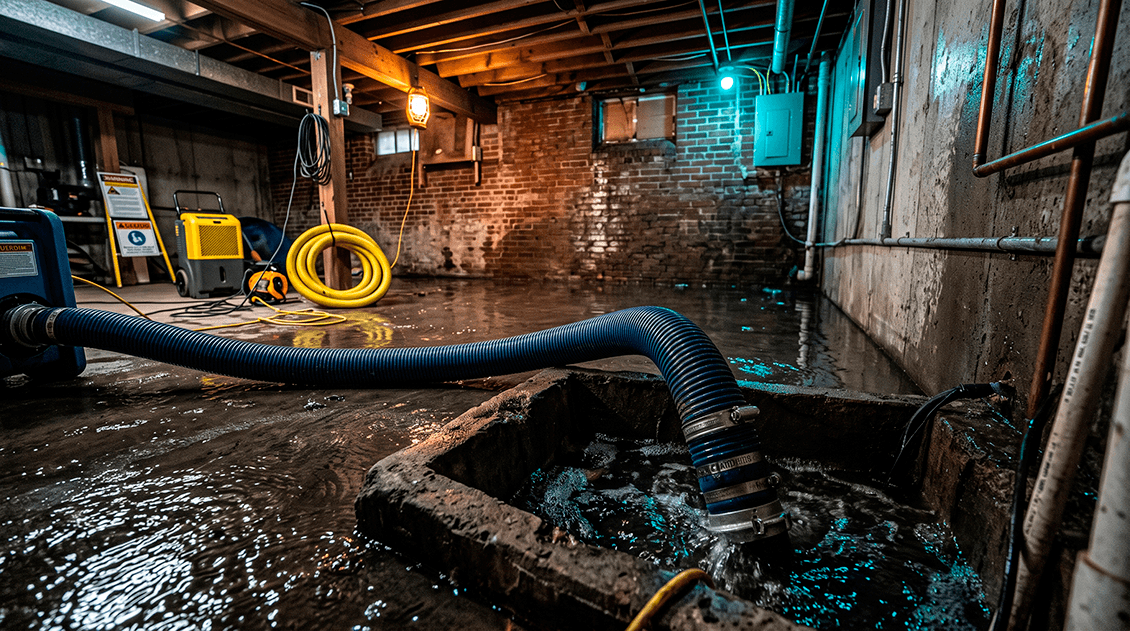
Heavy-duty utility vacuum hoses deployed into a flooded subterranean collection vault to intercept rapid fluid retention spikes.
When thousands of gallons of pressurized water bypass standard drainage limits, property assets face significant risk from rising hydro-static pressure. Liquid trapped beneath a concrete foundation slab works like a mechanical hydraulic lift, applying immense upward force against the masonry framework. If high-capacity vacuum pumping machinery is not deployed within the initial hour of failure, this pressure can trigger micro-fissures along building foundation walls and cause basement floor plates to buckle. Managing these sudden structural fluid accumulations across St. Louis County requires independent emergency response fleets equipped with heavy-duty truck-mounted pumping configurations capable of continuous high-lift fluid extraction.
Hydrostatic Accumulation Hazards and Main Drainage Backflow Profiles
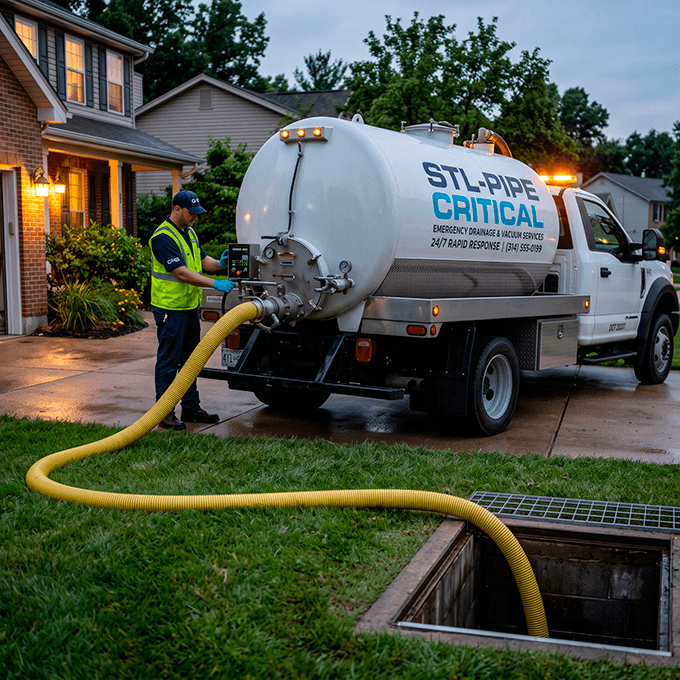
Advanced Ford F-550 heavy suction support units deployed to manage high-volume sub-surface main discharges.
Mitigating a severe basin discharge failure requires a precise understanding of metropolitan infrastructure limitations and structural material tolerances. In established communities throughout St. Louis County—including Chesterfield, Kirkwood, Webster Groves, and Florissant—thousands of commercial and residential building layouts depend on legacy clay or cast-iron main drainage sewer lines. Over decades of service, these underground lines experience inevitable interior degradation, including structural root intrusions, heavy calcium scale scaling, and pipe alignment shifts due to regional soil settlements. When an internal water line burst discharges a high-velocity fluid volume into these restricted drainage setups, the degraded lines cannot clear the flow rate, resulting in an immediate backflow condition.
The mechanics of a main drainage backflow are destructive and rapid. As wastewater collects in the lower levels of a property, the liquid quickly spreads across porous concrete surfaces and wall plates, threatening structural timber framing. This rapid fluid migration introduces direct biological and chemical contaminants into the indoor environment. To minimize property loss, on-duty emergency squads track regional failure patterns using centralized fleet logs. Deploying heavy-lift vacuum trucks from companies like STL-PIPE CRITICAL directly to vulnerable sectors ensures that high-lift suction lines can intercept rising wastewater volumes before sub-slab accumulations cause permanent foundation shifting or undermine supporting masonry columns.
Psychrometric Fluid Classification and Catch Basin Sanitization Protocols
Wastewater escaping from a backed-up sump basin or sewer main line cannot be treated as a standard plumbing leak; it requires immediate psychrometric and biological classification under professional IICRC S500 restoration guidelines. Unlike clean supply line splits (Category 1), basin discharge overspills are classified as Category 2 Gray Water or Category 3 Black Water from the exact second of entry. Because these retention systems collect environmental runoff, soil compounds, and household waste, the fluid carries heavy bacterial loads, active mold spores, and toxic chemical residues that present direct health hazards to building occupants.
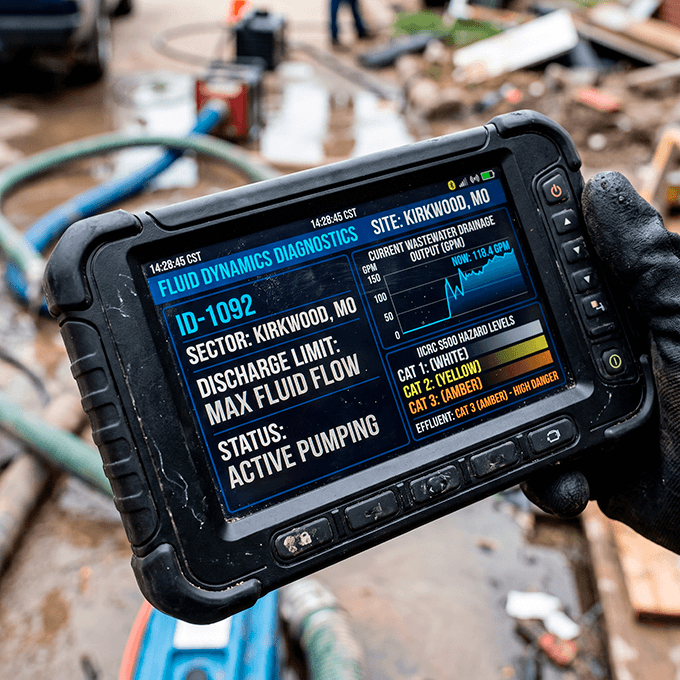
Digital tracking screen monitor registering real-time wastewater extraction flow metrics and containment parameters.
If standing basin water is left unmitigated for more than twenty-four hours, rapid organic decomposition transforms the environment into a highly hazardous biological zone. Microorganisms multiply exponentially within porous building assets like drywall matrices, support framing, and carpeting, making complete environmental isolation essential. Emergency extraction technicians use advanced truck-mounted vacuum systems to drain the flooded zone completely, then apply industrial-grade broad-spectrum antimicrobial treatments across all affected surfaces. This technical decontamination process eliminates hidden micro-flora and biological threats, ensuring the property can be safely prepped for thermodynamic drying procedures without risk of spreading airborne contaminants.
Thermodynamic Moisture Management and Foundation Vapor Extraction
After heavy-lift vacuum pumping machinery has cleared the bulk liquid volume from the basement floor, structural timbers and masonry blocks remain completely saturated with moisture. Concrete is highly porous, acting like a structural sponge that draws water deep into its mineral matrix through capillary action. Leaving this subsurface moisture unaddressed allows water to wick upward into wall plates, triggering rot and compromising structural strength over time. To reverse this moisture migration, mitigation specialists establish a precise vapor pressure differential between the damp building materials and the surrounding indoor air envelope.
Crews deploy rows of high-velocity axial air movers paired with heavy-duty Low-Grain Refrigerant (LGR) dehumidification units throughout the affected area. Air movers drive high-speed air streams directly across wet concrete and framing surfaces, breaking down the stagnant boundary layer of high humidity and accelerating evaporation. Simultaneously, LGR dehumidifiers draw the moisture-laden air across ultra-cooled internal evaporator coils, condensing the water vapor and draining it away safely. This continuous closed-loop system drops the relative humidity and grain levels (GPP) of the indoor air, forcing trapped moisture out of porous concrete structures to stabilize the building and prevent structural warping or material breakdown.
Documenting the Structural Proof Chain for Insurance Validation
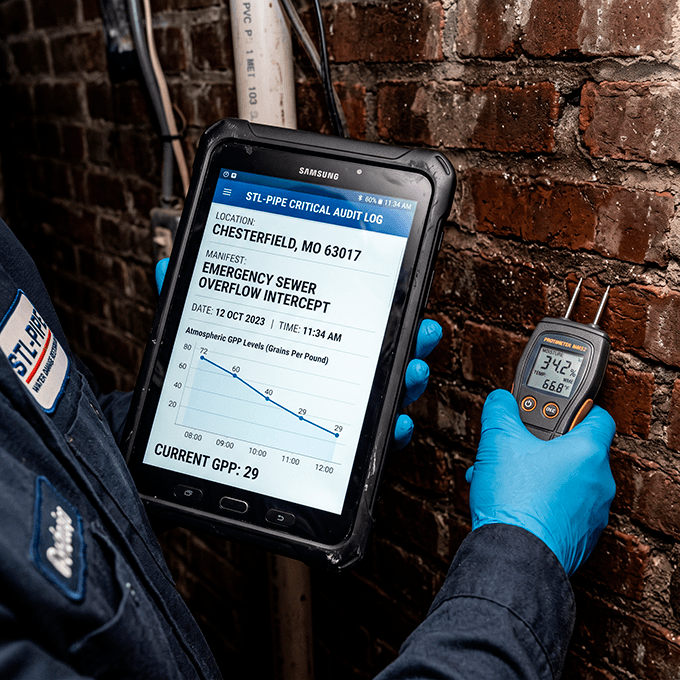
Completed digital water extraction log and psychrometric audit sheet used to validate insurance claim files.
Successfully navigating a major real estate insurance claim for water damage caused by basin or drainage failures requires clear, technical evidence and transparent records. Insurance adjusters evaluate basin overflow claims carefully, checking logs to confirm that the failure was sudden, accidental, and that the owner took immediate steps to stop the water flow and mitigate the damage. Without transparent, audit-ready field evidence detailing every step of the extraction and drying process, property owners can face serious administrative delays or reductions in claim payouts.
The independent restoration professionals in our database eliminate these administrative hurdles by providing comprehensive, digital manifest folders for every dispatch. These files compile initial thermal scans, daily moisture tracking charts, equipment run logs, and final dryness verifications into a single, cohesive proof chain. Providing this thorough documentation simplifies the review process, assisting property owners in validating their claims and securing fair, timely payouts from their insurance providers without processing delays. This complete system protects both the physical building and your financial interests from the impact of sudden line ruptures.