The Logistical Framework of Central Intake Management and Tactical Intercepts
The stabilization of unexpected sub-surface fluid breaches and municipal water distribution collapses within the St. Louis, Missouri region depends completely on the operational velocity of the intake framework. When a commercial property layout or a multi-family domestic structure suffers an immediate infrastructure breakdown, the speed of digital file calibration dictates the scale of subsequent real estate mitigation. An uncontained water line rupture doesn't present an ordinary repair challenge; it injects a massive kinetic volume that immediately puts intense physical load onto structural components. Bypassing the administrative delays common to legacy repair networks requires a fully integrated intake desk configured to prioritize field assets in real time.
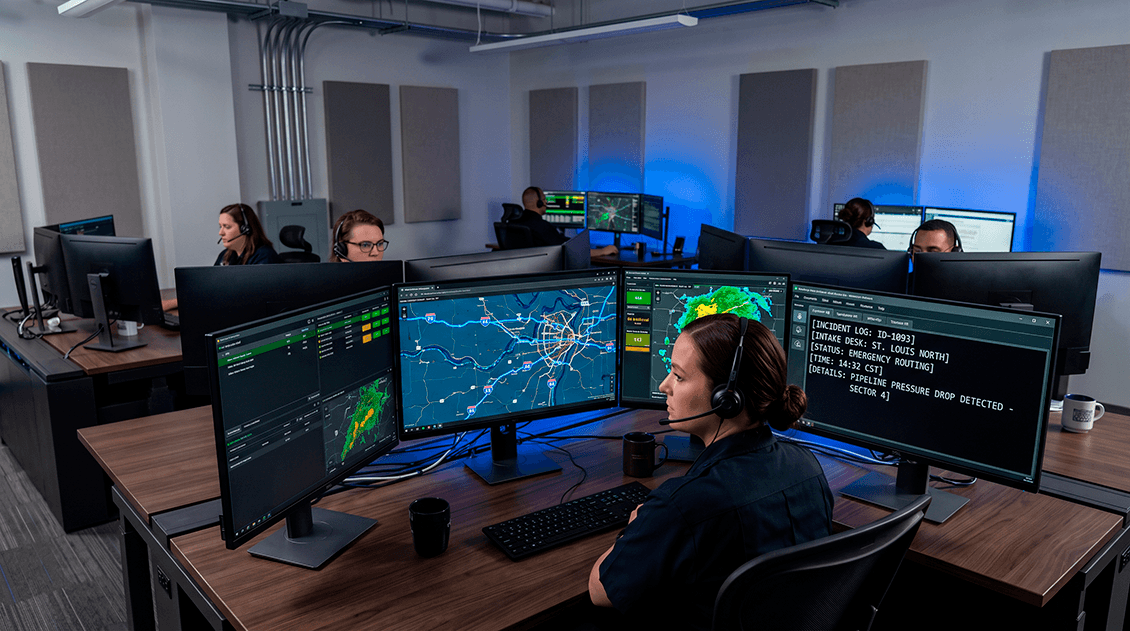
Centralized emergency communications database processing real-time intake routing files across St. Louis sectors.
Upon submission of an incident ticket, our automated diagnostic matrix instantly evaluates localized infrastructure stress points against active fleet coordinates. Emergency vacuum tank trucks, heavy support equipment trailers, and technical psychrometric response units are monitored continuously relative to major regional transit nodes such as I-64, I-70, and I-270. This thorough approach allows on-duty managers to coordinate direct routes into impacted municipal zones—including Chesterfield, Florissant, Kirkwood, and University City—within minutes of a recorded failure. Rapid logistical assignment ensures that heavy extraction assets reach the affected property within a targeted 45-minute response window, minimizing deep material saturation and preventing water volumes from migrating into porous masonry foundations.
Technical Calibration of High-Lift Suction Assets and Structural Safeguards
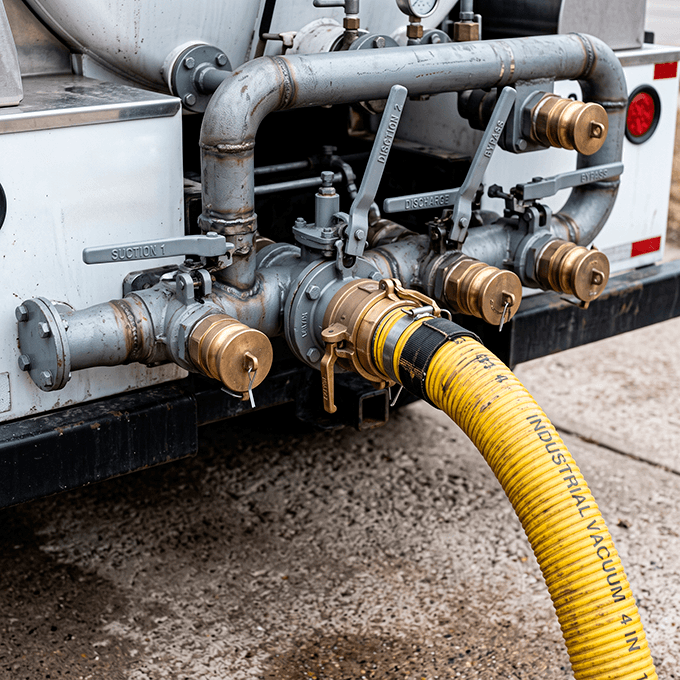
Heavy-duty mechanical manifold connections on an active vacuum tank asset deployed for foundation extraction.
Executing an emergency plumbing intercept involves significant mechanical control. When high-pressure supply systems suffer structural failure, the escaping water quickly travels down the paths of least resistance, pooling in low-lying building crawlspaces and basement sub-slab voids. Traditional portable extraction equipment lacks the lift capacity to clear deep subterranean accumulations before concrete blocks begin absorbing fluid. To handle high-volume disasters, contracted technicians deploy heavy Ford F-550 Super Duty vacuum tank trucks equipped with large steel horizontal cylinders and powerful positive-displacement air pumps that maintain constant vacuum pressure over extended extraction runs.
These specialized vacuum trucks operate by generating a sharp pressure drop within the sealed steel tank structure, pulling liquid through thick, reinforced suction hoses connected directly to the truck's rear manifold valves. Technicians run a single heavy-duty заборный рукав straight from the driveway, across the lawn, and down through a basement window grid to sub-floor sumps. This setup allows the machinery to pull hundreds of gallons of contaminated water per minute out of the building envelope, preventing standing pools from applying dangerous upward force against the concrete slab. Controlling this hydrostatic pressure early protects the property's foundation columns and prevents permanent shifting or masonry cracking.
IICRC S500 Hazard Progression and Intake Prioritization Standards
Every ticket processed through our central communications desk undergoes immediate evaluation according to the biological and environmental criteria of the IICRC S500 Restoration Standards. Water entering a property from a broken municipal main line is initially classified as Category 1 Clean Water. However, this safety status degrades rapidly upon contact with building elements. As pressurized fluid surges behind drywall sheets, runs under sub-floor layers, or mixes with dust inside structural voids, it instantly collects chemical dirt, soot, and structural materials, shifting to a Category 2 Gray Water classification that requires fast sanitization controls.
If the fluid extraction grid suffers an intake delay and stagnant wastewater sits inside framing cavities for more than twenty-four hours, the biological risk rises sharply. The wet environment becomes an active breeding ground for hidden mold spores, rapid bacterial multiplication, and accelerated material rot, transforming the incident into a Category 3 Black Water event. To stop clean water from turning into a hazardous biological issue, our intake system prioritizes files with active sewer backups or long standing times. Dispatched teams arrive equipped with advanced broad-spectrum antimicrobials and specialized containment barriers to isolate contaminated zones and protect indoor air quality before starting heavy pumping loops.
Thermodynamic Moisture Evaporation and Sub-Surface Vapor Balancing
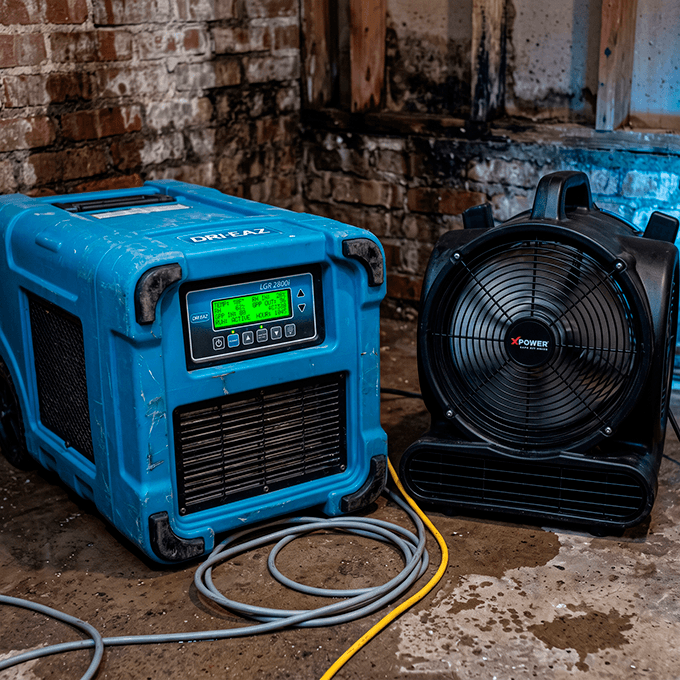
Professional thermodynamic extraction setup establishing vapor pressure differential across saturated masonry plates.
Completely restoring a building's safety profile after high-capacity pump trucks have cleared the bulk wastewater volume requires deep thermodynamic management. Structural elements like timber support plates, porous concrete sub-floors, and internal drywall sheets absorb moisture deep into their grain setups. Surface-level drying only handles the visible issue, leaving the underlying framing wet and vulnerable to long-term wood decay. To draw this deep water out, technicians set up a strict vapor pressure differential between the damp building materials and the surrounding indoor air envelope.
Crews deploy rows of high-velocity axial air movers paired with industrial Low-Grain Refrigerant (LGR) dehumidification units throughout the impacted zones. Air movers drive high-speed air streams across wet masonry and timber framing, breaking down the stagnant high-humidity boundary layer and accelerating evaporation. Simultaneously, LGR dehumidifiers draw the damp air across ultra-cooled internal coils, condensing the water vapor and draining it away safely. This continuous loop drops the relative humidity and grain levels (GPP) of the indoor air, forcing trapped moisture out of porous wood and concrete block pores to stabilize the structure and protect the property's long-term asset value.
Insurance Proof Logs and Comprehensive Claim File Verification
The final stage of an emergency plumbing intake involves compiling technical documentation for insurance loss verification. Large property insurance claims require comprehensive, clear field proof that details the sudden nature of the failure and the immediate mitigation steps taken to minimize structural damage. Insurance companies review claims carefully, and gaps in documentation can result in processing delays or reduced payouts.
The independent restoration professionals in our network eliminate these administrative hurdles by providing complete, audit-ready digital manifest folders for every dispatch. These files combine initial thermal infrared scans, daily moisture tracking charts, equipment run logs, and final dryness verifications into a single proof chain. Providing this thorough documentation simplifies the review process, assisting property owners in validating their claims and securing fair, timely payouts from their insurance providers without processing delays. This complete system protects both the physical building and your financial interests from the impact of sudden line ruptures.