The Physics of Water Hammer Anomalies and High-Velocity Line Tearing
The operational stabilization of catastrophic water line ruptures within St. Louis, Missouri infrastructure layers requires a clear understanding of fluid kinetic energy transitions. A sudden pipe wall rupture is rarely caused by simple baseline municipal water pressure. Instead, structural pipe failures are heavily driven by transient pressure spikes known as water hammer anomalies. When a high-volume valve shuts abruptly within a commercial building or municipal supply grid, the momentum of the moving fluid column is forced to a sudden halt, producing an instant reversal of kinetic energy. This deceleration creates an acoustic shockwave that travels backward through the plumbing line at speeds passing four thousand feet per second.
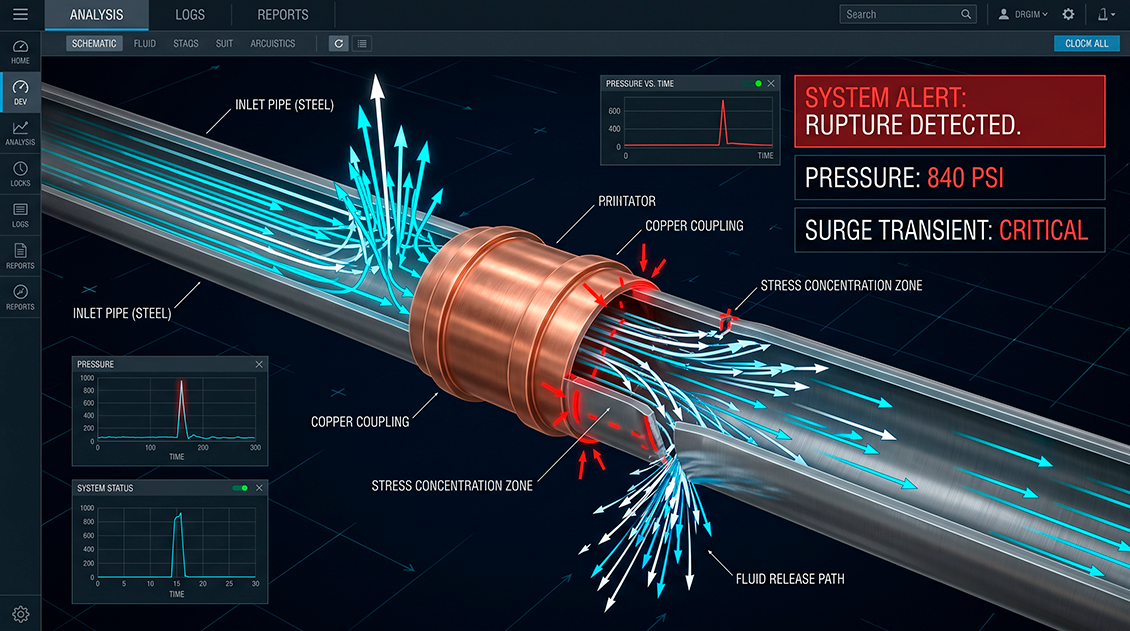
Technical breakdown of kinetic fluid surge propagation fracturing metal junctions under intense hydrostatic load profiles.
As this high-velocity pressure surge propagates through closed utility paths, it multiplies internal line pressures up to eight times standard limits, frequently exceeding 800 PSI. The pressurized liquid behaves like a solid hydraulic ram inside the pipe grid, seeking out weak connection nodes, soldered elbow joints, or areas thinned by continuous metallurgical scaling. When this severe internal force outperforms the material strength of the surrounding copper, galvanized steel, or cast iron matrix, the line splits apart instantly. This structural breakdown allows uncontained water to discharge into real estate layouts at high velocity, transforming a mechanical utility failure into an immediate structural property hazard across St. Louis County.
Logistical Intercept Strategies for Severe Fluid Surge Management
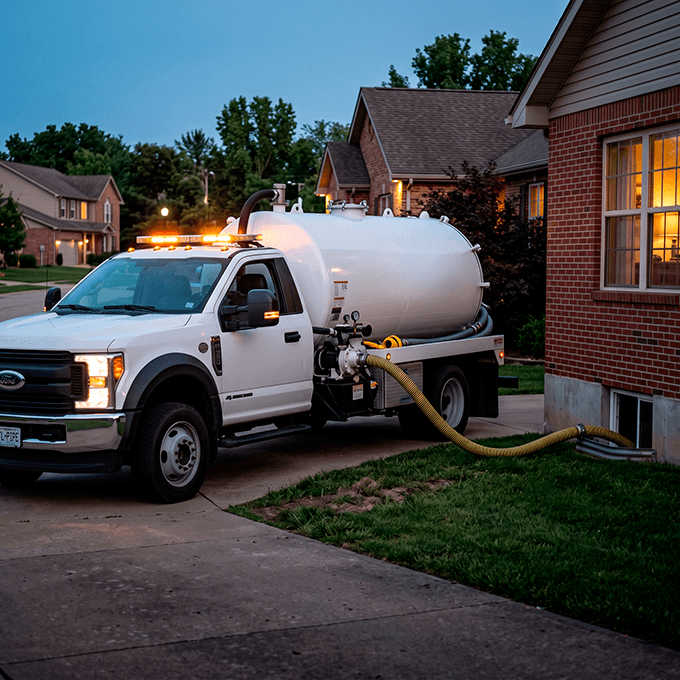
Heavy-duty vacuum tank truck deployed to route high-lift suction lines into a flooded residential foundation window.
When high-pressure water hammer fractures cause large-scale water discharges, managing the flooding requires a fast logistical response. Thousands of gallons of water escaping from a ruptured main line can flood sub-slab crawlspaces and basement structures within an hour. To stop water from migrating into porous structural assets, our centralized dispatch desk coordinates with specialized emergency response vehicles stationed near key St. Louis highway nodes, including the I-64, I-70, and I-270 corridors. This real-time positioning allows on-duty crews to respond to incidents across Chesterfield, Florissant, Kirkwood, and University City well within standard local arrival windows.
Field teams arrive on-site using heavy-duty Ford F-550 Super Duty vacuum tank trucks equipped with large cylindrical steel storage vessels and high-capacity positive-displacement air pumps. Unlike standard portable tools that struggle with deep subterranean water lifts, these truck-mounted units maintain steady vacuum pressure over long distances. Technicians run a single thick, reinforced suction hose directly from the truck's rear manifold valves, across the driveway, and down through a basement window grid to pump out the flooded sub-floor. This heavy-lift system extracts hundreds of gallons of water per minute, lowering hydrostatic pressure and protecting foundation slabs from cracking or shifting under stress.
Psychrometric Classification of High-Pressure Internal Overflows
Water discharged from a high-pressure line burst cannot be treated as a simple household leak; it demands immediate psychrometric and biological classification under professional IICRC S500 restoration standards. Fluid exiting directly from a treated main line begins its cycle as Category 1 Clean Water. However, this safety profile degrades rapidly upon entering a building envelope. The instant the pressurized water sweeps behind drywall panels, travels across basement concrete floors, or pools inside dark utility cavities, it absorbs old dust, soil compounds, and building chemical residues, transitioning immediately into Category 2 Gray Water.
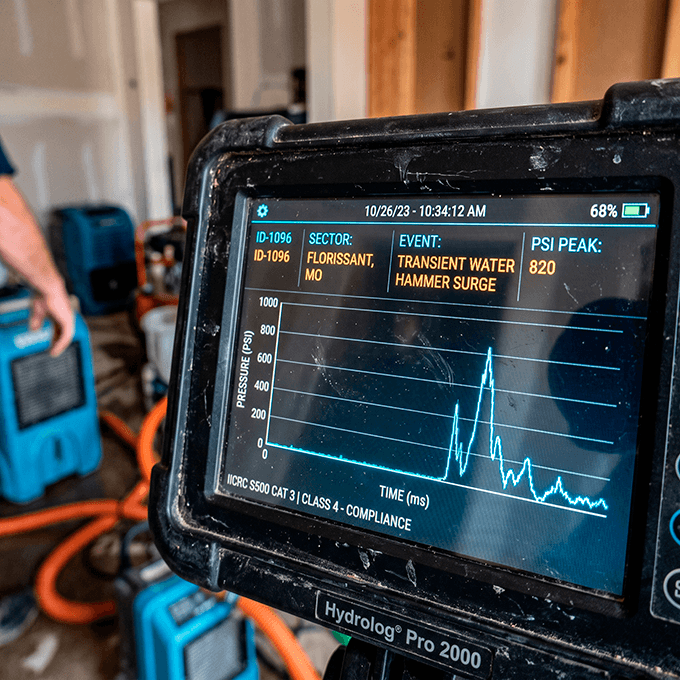
Diagnostic monitor tracking high-velocity fluid pressure spikes and real-time structural intercept coordinates.
If standing gray water is left unmitigated for more than twenty-four to forty-eight hours, the property risk escalates significantly. The stagnant moisture creates an active breeding ground for hidden mold spores, rapid bacterial multiplication, and organic wood decay, turning the event into a Category 3 Black Water hazard that threatens indoor air quality. To prevent clean water from turning into a toxic biological hazard, our dispatch system automates truck routing to ensure high-capacity extraction units reach properties quickly. Fast intervention allows teams to deploy broad-spectrum antimicrobials and clear standing pools before biological growth can damage structural timber framing grids.
Thermodynamic Vapor Extraction and Sub-Surface Core Prosecution
Completely restoring a property's structural soundness after a major water line break requires dropping moisture levels deep within porous building materials. Elements like timber support plates, concrete blocks, and drywall are highly porous and act like structural sponges, drawing water deep into their grain matrices through capillary action. Simply evacuating the surface water layer handles the visible issue, but leaves the underlying framework wet and vulnerable to long-term wood decay. To draw this deep moisture out, technicians set up a strict vapor pressure differential between the wet structural materials and the surrounding indoor air envelope.
Crews deploy rows of high-velocity axial air movers paired with industrial Low-Grain Refrigerant (LGR) dehumidification units throughout the impacted zones. Air movers drive high-speed air streams directly across wet masonry and timber framing, breaking down the stagnant high-humidity boundary layer and accelerating evaporation. Simultaneously, LGR dehumidifiers draw the damp air across ultra-cooled internal coils, condensing the water vapor and draining it away safely. This continuous loop drops the relative humidity and grain levels (GPP) of the indoor air, forcing trapped moisture out of porous wood and concrete block pores to stabilize the structure and protect the property's long-term asset value.
Documenting the Hydrostatic Failure Proof Chain for Insurance Adjusters
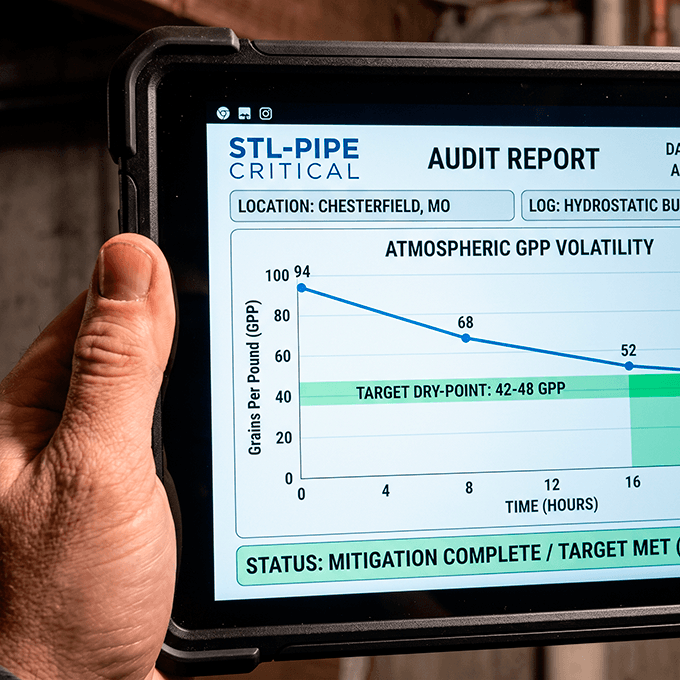
Completed digital drying manifest and psychrometric report used to validate sudden pipe fracture claims.
Successfully navigating a large real estate insurance claim for water damage caused by water hammer pipe splits requires clear, technical evidence and transparent records. Insurance companies evaluate sudden line fracture claims carefully, checking logs to confirm that the failure was sudden, accidental, and that the property owner took immediate steps to stop the water flow and mitigate the damage. Without transparent, audit-ready field evidence detailing every step of the extraction and drying process, property owners can face serious administrative delays or reductions in claim payouts.
The independent restoration professionals in our database eliminate these administrative hurdles by providing comprehensive, digital manifest folders for every dispatch. These files compile initial thermal scans, daily moisture tracking charts, equipment run logs, and final dryness verifications into a single, cohesive proof chain. Providing this thorough documentation simplifies the review process, assisting property owners in validating their claims and securing fair, timely payouts from their insurance providers without processing delays. This complete system protects both the physical building and your financial interests from the impact of sudden line ruptures.